TheNewport Country Clubremains one of Rhode Island’s greatest architectural achievements. Designed by Whitney Warren and founded in 1893, itisone of the five founding member clubs of the United States Golf Association. Originally created for Newport’s elite, the club continues to embody its legacy of elegance and exclusivity.
Whitney Warren
PHASE I: EXTERIOR RESTORATION
Like many buildings of its era, the Newport Country Club was not well preserved during the 20th century. By the early 21st century, decades of poor maintenance and poorly conceived interventions left it structurally unsound and aesthetically bereft.The club retained MCWB Architects to evaluate the building for its possible renovation and rehabilitation.
Exterior before restoration
Front entrance after restoration
RESEARCH & ANALYSIS
During the preparation of the HistoricStructureReport, the architectural team rediscovered the building’s breathtaking original appearance. MCWB developed a restoration and rehabilitation plan that would revive its former splendor and meet the needs of a modern country club.
REALIZATION
Club members enthusiastically endorsed MCWB’s vision and moved to complete the work before the 2007 Women’s United States Open. During that event, the club was proud to display the newly restored building for its daily visitors. The east porch and surrounding landscape was also reconstructed giving members a beautiful overlook of the golf course.
PHASE II: INTERIOR RESTORATION
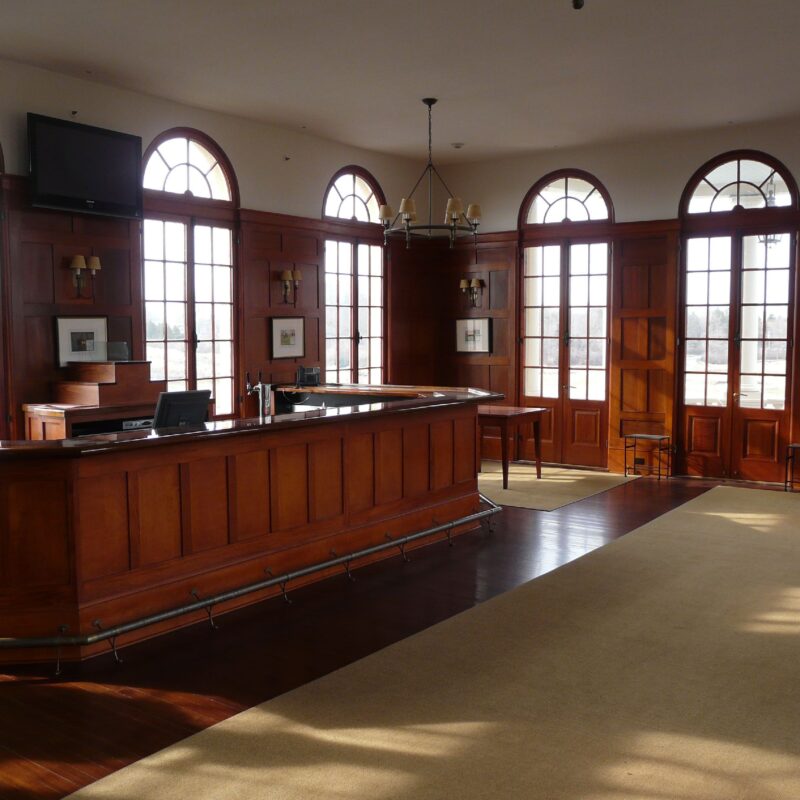
The restoration and rehabilitation plan for the interior of the club began with the importanceof reinstating Warren’s original floor plan.This was used as a benchmark for the planning process. The scope included relocating the women’s locker room andaddinga bar and lounge area. This gave the members of the club the opportunity to once again enjoy the vistas from the room.
RESEARCH
The original Beaux-Arts plan brilliantly captured key vistas and flooded the interior with natural light, while its axial layout created striking views within the building. Despite changes in room functions over time, the restoration process prioritized the original design intent. For instance, the north wing, originally designed as a drawing room with windows on three sides and sweeping views of the golf course, was converted into a women’s locker room in the mid-20thcentury. To accommodate its new use, the windows were covered, diminishing natural light and compromising the building’s lantern-like quality.
REALIZATION
The restoration sought to reverse these changes, honoring the building’s original character and design principles.The building was designedwith small wet cellars beneath each wing, separated by a solid ledge in the center.MCWB removed the ledge to create expansive dry spaces, which now house mechanical rooms, offices, public bathrooms, a pro shop, and golf bag storage.